Cecil B. DeMille Movies List (Filmography)

Cecil Blount DeMille (; August 12, 1881 – January 21, 1959), often known in popular culture as Mr. DeMille, was an American filmmaker and actor. Between 1914 and 1958, he made 70 features, both silent and sound films. He is acknowledged as a founding father of American cinema and the most commercially successful producer-director in film history, with many films dominating the box office three or four at a time. His films were distinguished by their epic scale and by his cinematic showmanship. His silent films included social dramas, comedies, Westerns, farces, morality plays, and historical pageants.
Born in Ashfield, Massachusetts and raised in New York City, DeMille began his career as a stage actor in 1900. He later began to write and direct stage plays, a few with his older brother William de Mille, and some with Jesse L. Lasky, who was then a vaudeville producer. DeMille's first film, The Squaw Man (1914), was the first full-length feature film shot in Hollywood. Its interracial love story was commercially successful, and the film marked Hollywood as the new home of the U.S. film industry. Based on continued film successes, DeMille founded Famous Players Lasky which was later reverse merged into Paramount Pictures with Lasky and Adolph Zukor. His first biblical epic, The Ten Commandments (1923), was both a critical and commercial success; it held the Paramount revenue record for 25 years.
DeMille directed The King of Kings (1927), a biography of Jesus, which gained approval for its sensitivity and reached more than 800 million viewers. The Sign of the Cross (1932) is said to be the first sound film to integrate all aspects of cinematic technique. Cleopatra (1934) was his first film to be nominated for the Academy Award for Best Picture. After more than 30 years in film production, DeMille reached a pinnacle in his career with Samson and Delilah (1949), a biblical epic that became the highest-grossing film of 1950. Along with biblical and historical narratives, he also directed films oriented toward "neo-naturalism", which focused on portraying the laws of man fighting the forces of nature.
DeMille received his first nomination for the Academy Award for Best Director for his circus drama The Greatest Show on Earth (1952), which won both the Academy Award for Best Picture and the Golden Globe Award for Best Motion Picture — Drama. His 1956 remake of The Ten Commandments became his final and best-known film; also a Best Picture Academy Award nominee, it is the eighth-highest-grossing film of all time, adjusted for inflation. In addition to his Best Picture Awards, DeMille received an Academy Honorary Award for his film contributions, the Palme d'Or (posthumously) for Union Pacific (1939), a DGA Award for Lifetime Achievement, and the Irving G. Thalberg Memorial Award. He was the first recipient of the Golden Globe Cecil B. DeMille Award, which was named in his honor. DeMille's reputation had a renaissance in the 2010s, and his work has influenced numerous other films and directors.
Read more...Cecil B. DeMille Movies List
Cecil B. DeMille Films and Movies Timeline (1 Pixel = 1 Day)

The Girl of the Golden West

Chimmie Fadden Out West

The Little American

The Squaw Man

Something to Think About

Why Change Your Wife?

The Godless Girl
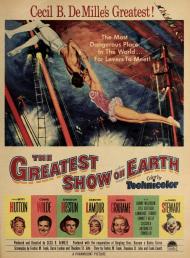
The Greatest Show on Earth

The Ten Commandments












Voting Rules
- You can vote up or down. Please always consider the context when voting, e.g. a song should be voted up or down with respect to the other songs contained on the album, an actor's performance in comparison with other actors in the same movie, a book with respect to other books by the same author or within the same genre.
- A vote can be cancelled by simply clicking the opposite vote within 24 hours. You can then vote again on the same item.
- Each user has one vote per item within a specific list every 24 hours. After 24 hours you can vote again on the same item within the same list.
- You can vote on as many items as you like within a list or on the same item if it's part of another list. For example, you can vote David Bowie up or down on the list of pop music artists as well as on the list of indie rock artists and on the list of rock music artists. etc.
- Happy Voting!